Mt Whitney, CA - A Quick Pop-Up
In this personal Story Pop, Philip takes you inside the day he climbed Mt. Whitney — the highest peak in the Lower 48 — in just 10½ hours with three friends, a September weather window, and a chance encounter with a man known only as Crazy Jack, who has summited Whitney more than 200 times.
It’s a story about preparation, altitude, friendship, and the strange magic of a mountain that meets you exactly where you are. From the permit win during the April release (“the second‑chance window”) to a training arc in the Ruby Mountains, to the headlamp start at Whitney Portal at 2 a.m., this episode follows the emotional arc of the climb — the switchbacks, Trail Crest, the summit, the descent, and the lessons the mountain leaves behind.
If you’ve ever dreamed of doing something big in a single day, this one’s for you.
Off you pop.
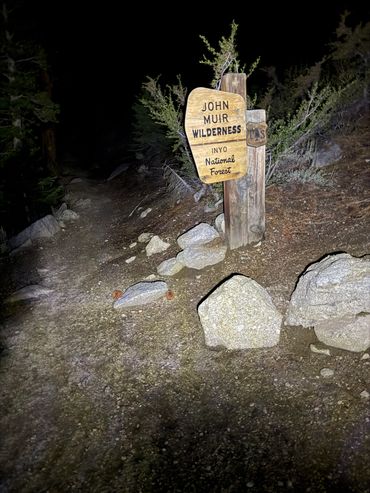
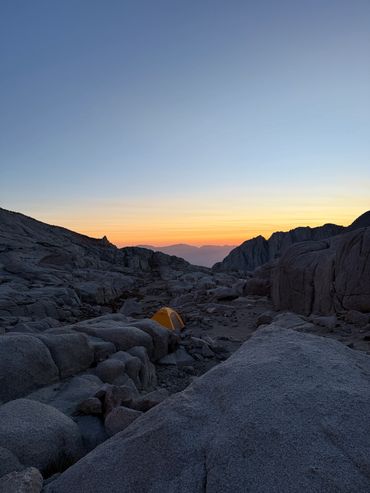
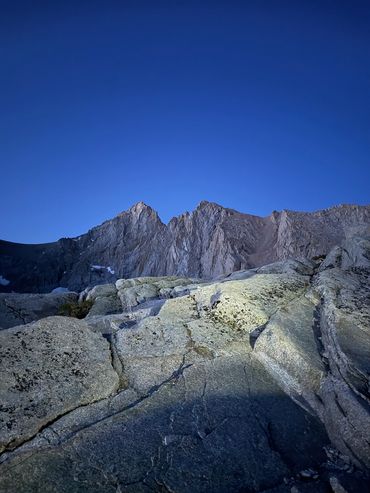
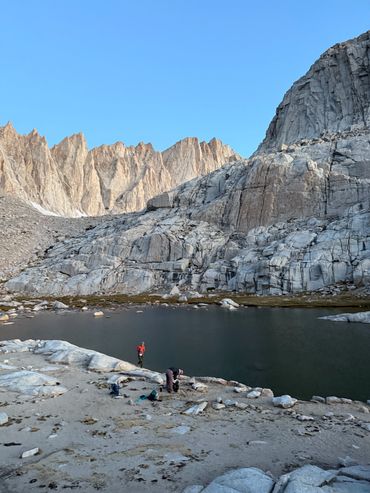
Off You Pop Unfiltered: The Photo Gallery
Episode Transcript
Introduction
This is Off You Pop, a podcast for hikers and adventurers who want to be epic in just one day. Today's episode is a story, Pop, a personal one. A story about Mount Whitney, the highest peak in the lower 48, and the day I climbed it with three friends, a fast pace, a September weather window, and a man named Crazy Jack who summited this mountain more than 200 times. This is the story of how we got the permit, how we trained, and how the day unfolded, and what the mountain taught me. This is Off You Pop.
Plannin gnad Training for Mt Whitney
So, climbing Mount Whitney doesn't start the week before. It starts in the spring. There's a lottery window. Usually opens up in February. Well, in early April I remembered about the lottery window and realized I'd missed it. But there is a second chance release when all the dates that have not been allocated for the lottery get released in April. And so I set my uh calendar an alarm for the day that they were going to release the dates. And at 7 a.m. that morning I logged on, quickly scoured what the availability was at the weekends and found four spots in September. And I snagged them. And then I realized, wow, we're going to do it. We got the permits. And so I quickly texted my two friends who were coming with me, Jason and Leo, who you all hear a lot about in this podcast. And we shifted straight from maybe we'll do this one day to, oh my God, we're going to do this. Absolutely awesome. And so I'd also texted Jason, said, Jason, get on at seven o'clock. We could get permits. And he had also got on the permit and got he'd got permits for a different date in September. So we had double the permits. So we were definitely going. There was no way we were not going to do this. Everyone was super excited, especially Leo, who had made the mistake one year of ignoring what I told him about the lottery and said, Why are we not going to Mount Whitney? I want to go to Mount Whitney this weekend. And I told him you need a lottery ticket. And we didn't get the lottery. So he was very, very disappointed that we had not got the lottery ticket that year. And we ended up climbing White Mountain Peak, which is actually not too far from Mount Whitney, just outside the town of Bishop. It's also 14,000 feet and was was an epic adventure, but that's another story for another day.
And so the next day, I was very excited. I went to the the gym where I was working out and I had some friends there. And one of them I knew was really into hiking and would really get why it was so exciting. And I was explaining to him, I got four permits for the for Mount Whitney. He was like wide-eyed because I knew he was really into hiking. And I told him, well, three of my friends are coming and I have one permit left. And he immediately turned around and said, I want to do that. Let me check my calendar. Don't give the permit to anybody else. I need to check my calendar and I'll get back to you. And so a couple of days later, I went back to the gym and he was there and he's I'm in. I'm in. He was super excited too. So we're all excited. We got a group of four of us who are ready to go and climb Mount Whitney and just on a high and now reality setting. We were going to attempt to climb a 14,000-foot mountain. And all the logistics had to happen. We had to figure out how to get there, where to stay, what the rules were, and all that good stuff. But for that moment, we were just all elated and excited that we'd finally gotten uh to live the dream, get to our big bucket day hike and climb Mount Whitney.
So anyway, the year, the year dragged on, and Brady had said, you know, I don't think I'm ready to climb Mount Whitney. And he called me up one day and said, Hey, I've always wanted to do the Ruby Mountains through hike. Now the Ruby Mountains are in northeast Nevada and they are described as the Alps of the West. And he said he'd been there, he'd been up there quite a lot to go hunting and exploring, but he had never done the done the through hike on the Ruby Crest Trail. And so I'd done a lot of hiking and I'd been away a lot, but I asked permission from the lady of the house, and she said, absolutely, you can go do that. And so I was definitely in. The rubies were definitely on my list being in Nevada. I'd heard about them. I'd seen them from the town of Elko, but it had been in the winter, and was definitely excited to go. And it made sense that this would be the perfect pre-Whitney training hike. So the Ruby Crest Trail is 37 miles long, and the Rubies sit at just about over 10,000 feet. And so a lot of the time when you're doing the trail, you're over 10,000 feet. So you're getting that elevation experience, you know, the the air, the the cool air, you know, the thin air, and getting really time on feet. And so I did the research, and most of the folks that are doing the Ruby Crest Trail are taking four days to do it. And I felt like we could probably do it in three days. So we set up to do it in in three days.
And Brady and I left on a Thursday afternoon and drove the four or five hours out to Elko and had arranged to meet in the town. And the plan was we would park a car at one end and then drive to the other end of the trail and then sleep the night at the trail and then work our way, you know, across the across the ridgeline and pick up the car and and and go collect the other car. And so I met up with Brady in the town of Elko at a gas station just on the edge of town. We could see the Rubies in the background and we were both pumped to do it. And we just you know went to the bathroom in the gas station facilities for the last time we were going to use a bathroom in a two, three days. Got last last-minute stacks, and then, you know, the day was closing in, so we didn't really hang around. We had to drop one car up in the Lemoyle Valley. So I dropped my car there, and then I jumped in his car, and we drove probably it feels like 45 minutes an hour to the other end of the trail. You sort of have to come out of the rubies and then go up through, you sort of follow the Ruby Mountains up the valley, and then you you get to Harrison Pass. And Harrison Pass is a little bit off-road. And we went, we drove up to the trailhead and parked up his truck and then figured out where we would sleep. So he was gonna sleep in the bed of the truck. And I decided to sleep in the back seat. And we had a bit of, you know, had some drink, settled down, and then tried to get some sleep. And I can tell you it's not very comfortable to sleep in the back of a a truck, even though it was like leather seats, it was still pretty hard and uncomfortable. But despite uncomfortable night's sleep, maybe a two or three hours sleep, I did manage to get some shut-eye.
And then at four in the morning I woke up. I don't know, I seemed to get up at four or five in the morning naturally. And Brady had also woken up, so it was 4 a.m. and we packed our stuff up, locked up the truck, and then in the you know, in the darkness, you know, began the hike. And so the hike actually starts out pretty, pretty flat for the first couple of miles, but then it starts to go in and out of these valleys. And so around 5, 5.30, the light starts coming up, and we can see we're at. And it wasn't too difficult to begin with. It was just a little bit of in and out of valleys, and maybe around 7 a.m. we stopped for breakfast and we filtered some water in a stream, and it was it was a beautiful, beautiful morning. We'd found a stream that was surrounded by aspens, and so we were just sitting there refilling water, taking in a snack and enjoying enjoying the morning. And then after that, it got a little bit more challenging. So we started to traverse down into the valley and then climb up to 10,000 feet. But it was July and it started to warm up a lot, and I was not used to carrying a full-on backpack with a tent and all the gear, and so it started to get a little heavy and a little hot. And as we started to climb up the mountain, Brady poured away a little bit from me. He'd been a little bit more used to carrying a bit more weight than I had, and the heat really started to get to me, and I had to take a little rest and try and cool off somewhat. So I found a stream and started just to to recover a little bit. And then it was the big climb up to 10,000 feet, and around 9,800 feet, it just hit me. The altitude. I was breathing heavily, moving slowly, just I, you know, I climbed over 10,000 feet quite a lot, but it'd been a while. And uh, we just come up from from Reno about 4,500 feet, and it got me good. And so it took a little while for me to catch up with Brady and we topped out of the ridge at 10,000 feet, and then it was just a sharp uh set of switchbacks down to Overland Lake, which was going to be our camp for the night. So we did 14 miles the first day.
We finished at two in the afternoon, and it was a really beautiful spot. It was this perfect ocean, perfect alpine lake, and behind it are these beautiful mountains just sort of jutting up behind the lake. What the we'd just come up and over and then back down into the switchbacks. And so when we're there, we met a couple of folks there who had or been there a bit longer than we had and had camped out. And we met a couple of geology students from the university, and I spent a little bit of time chatting with them about what they were doing and pretending I knew more about geology than I did. They were both PhD geology students, so I'm sure they were just entertaining me. Look at this guy trying to pretend what he that he knows about geology, and uh but it was really interesting. They were both out there doing some mapping of different structures out in the Ruby Mountains that hadn't been done a while, and so it was good to just sort of you know learn a little bit more about the geology of the mountain range. And then I sort of peeled off and joined Brady. And Brady had bought a fishing rod, and I thought it would be cool if we did some fishing, but he decided it wasn't gonna be cool and he couldn't be bothered, because it'd been a fairly long day already. We've been up at four in the morning and hiking, you know, 14 miles and put some big altitude in already. But it was great sitting there on the lake as the evening came in. You could see the fish just popping up out of the lake. I had bought one of those you know terrible freeze-dried meals and decided to cook that for dinner, and it was edible if you added a little bit of you know, salt and pepper and a little bit of spice. And so I ate that and I thought I didn't want the food container hanging around because of bears, you know. Uh so I washed it out in the lake, the food, and suddenly the fish came up and started eating my leftover mountain man mill or whatever it was. And then we decided it was probably it was starting to get dark and it was time to to go go to bed.
So I had this terrible one-man ten that it was impossible to make stand up correctly with the rocky stuff, but I sort of managed to cobble it together in a half-assed way. Absolutely no expertise in putting up a tent, apparently. But I made it work and got into bed, and the darkness began to fall in. And I remembered I needed the bathroom, which was an interesting experience. So in the dark I had to figure out a place where I could do my business that was out of the way and off the trail. And while I was out there, you could hear rustling out there in the bushes, and I figured it was some sort of animals. But fortunately, they didn't come to investigate. They were probably scared off by the smell, and went back to bed and the wind was really picking up. And so that evening I spent basically scaring myself with the sounds of the outdoors. And, you know, there's the wind would rustle and rustle the tent, and then I definitely heard foot footprints behind behind my tent in the dark, sort of, but I couldn't tell where they were coming from because the wind was a little bit disorienting. But it made for a fairly uncomfortable night's sleep.
But I I guess I must have got a couple of a couple of hours, but then 3:30 I'm awake. It's getting to 4 a.m. I thought, you know what? I'm just gonna wake up and I'll make myself a cup of coffee and just slowly start getting up and then wait for Brady to get up. But lo and behold, within me 30 minutes of me firing up some coffee, Brady got out of his tent and he was ready to hike. So at 4 a.m. We packed everything up, you know, we're trying to be quiet. There were other people out there in the, you know, in the campground, but we got our stuff together and then started doing the rest of the hike. And then the hike got absolutely spectacular. The traverse along the ridgeline of the Ruby Crest is something uh you have to experience. I must say I struggled with the backpack. I thought I was a tough guy. I did a lot of weight training, but I wasn't used to the extra weight of the backpack. So the day sort of started to become a bit of a sufferfest, and Brady was certainly up ahead of me a lot of the way. A lot of it was fairly doable switchbacks, but they were long climbs and sort of up and over passes all day. And I remember we came up to a particularly high point and we were looking to climb one of the peaks that was just off the trail. It's called Wine's Peak. And so we got up to Wine's Peak, and it was basically just a little bit off the trail and a little bit higher. But that's the one of the peaks that you can do there. So we we bagged Wine's Peak. It was pretty pathetic to be honest, but we did it.
And then Brady set off again, and I came over a ridge. He was probably, I don't know, four or five hundred yards ahead of me, and I was at the top of uh the path, so he was down in sort of a little coal in a little valley. And I'd stop for a rest, go take on some fuel, maybe get get a little bit hydrated, and I could see Brady on the ridge suddenly get very animated. He's jumping up and down and his arms are in the air, and he's really, really excited. And I see these birds fly over his head, and he was so excited. I could tell from that distance how excited he was, and I knew what it was. Brady had told me on the trip that he uh had been coming to the rubies for years and because he'd been hunting these birds called the Himalayan snowcocks. And they'd been being introduced to the rubies back in the days of Theodore Roosevelt, and they were notoriously hard to hunt because they lived on the edge of cliffs, and whenever you attempted um to shoot them, they just fly out into the abyss. And so he but he was so pumped and so excited just to see them. It was very interesting to me to think that here's a guy who wants to hunt and kill the birds, but he was just so excited and so pumped to actually have seen them and actually been that close to them. He said he didn't care that he wasn't gonna hunt him, he didn't have a gun, he's just so excited to see them. So it was really interesting uh seeing how excited he was as a hunter just to experience them. And I learned a lot that weekend about folks that hunt. You know, I'm not a hunter, I'm kind of anti-hunting, you know, my British background, we don't, it's not really a big thing in England. And what I learned was that Brady had sort of this instinct to be able to spot wildlife that was camouflage in the brush and knew the names of all the birds and the animals, we'd be hiking along and he'd say, Oh look, you see that deer, and I'm looking out into the abyss. I don't see a deer. He's like, No, no, look, right there. And I I like nodded, but I did not, I didn't see the deer. And then there's suddenly some birds would fly up and say, Oh, look, there's some some grouse of some description. I'm like, Yeah, yeah, that's great. I I didn't see them, and they suddenly, poof, up they go.
So we kept on hiking that day, and we were making some good time, but god, that pack was getting heavy. And around 11 a.m. we stopped at another big lake for the final big climb of the day. And we both sat there for about half an hour or so, refueling, rehydrate, rehydrating, ready for the big climb up to Liberty Lake. We didn't actually stay that long. We got refreshed and began the the hard the last hard climb of the day up to Liberty Lake. And he left me behind again, but it was a spectacular climb. You know, we started to find find other people who are coming from the Lemoille end. A lot of folks will leave from Lemoille and end up, you know, back coming in from that end, coming to the lake, and then heading back for the day. So we started to see hikers and started to interact a little bit more with hikers, but we get to Liberty Lake. Wow, that is also a spectacular lake, very similar to Overland Lake. I think it's a little lower altitude, but you have this beautiful crystal lake with these tall mountains jump jutting up. And I'm there on my own. I'm trying to figure out how do we get out of here because it's like a bowl with sheer, sheer cliffs. And so I started to follow the trail, and it gets switchbacky and real steep. And uh uh eventually I did find the trail, but it was a hard, hard fork trail. And eventually I finally made it to the top of the pass, and we could see the Lemoille Valley open up before us, and way in the distance was a parking lot where I knew my car was. And at that point, I caught up for Brady with Brady, had been waiting for me, and uh I love a good downhill, and so I sort of reinvigorated that I made the hard part of the day, and my pack had sort of grown up to be a part of me, even though it was bothering me somewhat. And uh then I made good time down the mountain and Brady was sort of keeping up, and so we started to see more and more tourists. Eventually we made it to the car. We made it to the car at 3 p.m. So we did the four-day hike in probably about a day. You know, we started at four in the morning and both times we ended early afternoon. Anyway, big training hike. Oh, the now the big day.
On the Pop: My Journey
So finally we were ready for the big day. And so Jason and Leo were gonna meet us down at a Whitney. We'd both book some motels in uh in Lone Pine. And we met up that evening for dinner. I introduced Brady to Leo and Jason, and uh we had uh some big burgers down in the town and uh got ready and fueled. And it was time to go to bed. We we knew we had to be up at two, so we could be at the trailhead sort of 2.30, ready to go. But everyone was super pumped and super excited. I dispensed the El Crap bags. If you don't know much about Whitney, it's an absolutely leave no trace. That includes your personal waste, so you're required to take these bags. I think there might be some available at the trailhead, but I just found these El crap bags online and was thoroughly entertained by the name, and so I paid extra and got these bags and distributed them. I did tell them I didn't want them back afterwards, they they could keep them, you know, a souvenir that they could keep on their shelf, used or unused, it was you know, it's up to them. So anyway, it was a great team.
So we drive up to Whitney Portal, which is the start point of the hike, and the parking lot was already cramped forward, so we had to go in the over the overflow parking lot, but it's not that far. It's you know, less than a hundred yards, a little bit down the mountain, but not uh strenuous or arduous or out of the way. We all meet up together and we we're standing in the dark, the beginning of the trailhead, and everybody's like, well, who's gonna lead? Who's gonna go first? Someone's gonna go first, and so nobody was making that decision. All right, I'll go first. I mean, it's pitch black, no one knows where the trail's going. We got a rough idea. I've certainly studied the route, but they decided I was gonna be the one that led. So it was a beautiful, clear night. You could see the stars, and we all had our headlamps on. And so I started the ascent up into the abyss, up through what is effectively a portal. And it starts with fairly gentle switchbacks. I mean, they are, I think they're graded. I'm gonna call it the national park grade. There's a sort of a certain grade that national park trails tend to go on, and it's not overly strenuous, at least, you know, to start with, but it's a lot of switchbacks. We can see up in the distance there's some headlamps fluttering up there, some people who left a little while before us. And so I just, you know, head down in the dark. I decided not to use poles early on, which was going to be a mistake that would bite me in the butt a little bit later, because the grade wasn't that hard. And I wanted to save the poles for when I really, really needed them, you know, when the trail got tough and steep. And so it was me leading, and I started off, you know, I thought it was a gentle pace, and slowly, slowly Jason and Leo started drifting behind, but I could still see their headlamps. And probably within the first half hour, we started catching up with slower hikers. And I thought, am I moving too too quickly? Am I burning myself out early? As the excitement got the best of me. We started, we first we passed one couple and then another, and we started switchbacking up. And I could see Jason and Leo a little, maybe a couple of switchbacks down, so I wasn't too worried about it. Then suddenly this woman comes flying past me. She's hiking, but she is power hiking. And so we let her pass, and then her boyfriend or her male support person comes up behind. I said, and she said, Oh, she's gonna try and break the record on the John Muir trail, which is you know like a 200-mile trail. And so suddenly I felt I maybe I wasn't going too fast. It was it was okay. I certainly didn't have have her her energy.
So you got these switchbacks that feel like they're in the open, and then suddenly you go into this dark woodland with these log bridges that cross a fairly gentle stream. So we crossed those, got into the darkness. Brady said he needed uh a toilet break. I said, okay, you can just catch up. And so then I found myself alone in these dark, very quiet, very dark woods, trying to navigate through the darkness. And suddenly I see uh a branch in the trail. One one branch of the trail is leading off to another, a lake that's fairly low on the trail, and a guy comes out. I said, Which way? To Mount Whitney, like an like an idiot. And he's like, No, you've got to go that way. And so I followed the trail and started, as you come out of the woods, you start going up and just a little bit of a switch, it gets you up a little ridge, and you keep going through the woods, and it starts to open out again. And now you're in another big open expansive space. And in the darkness, you don't know what it looks like. So it's the interesting thing about hiking before dawn is you don't know what's around you. You sort of you're in that cone of the headlamp, and in many ways, that makes hiking much more easier because you can't see how driver. The landscape around you is. You can't really tell how steep the trail is. You don't have that psychological, like, oh, I've got to climb that thing in front of me.
Anyway, we come up to another lake, and there's some people camping out there. So you take your time. Brady caught up to me by that point. We pass through the trail, camp, and then the hard bit starts to come. You can tell you're entering, even in the dark, you can tell you entering to a much more dramatic, much more rocky, much more exposed climb. And it starts to become a little bit more challenging to navigate. You can see the trail, and the trail is never super, super steep, but you do start switchbacking and you can feel like you're on the ribs of the spine of sort of a spur that you're climbing up. And you start climbing up the spur, and it's start it's starting slowly, slowly to get lighter. So slow slowly, slowly, it becomes you know a little bit easier to navigate. I'd made a few wrong, like, oh, this looks like the path. No, this is not the path, and sort of trying to navigate through that. I made a few errors, but at this point, there was no more Jason or Leo headlamps. So we had left them behind a little bit. And so I'd made the decision that when we got to trail camp, which is the famous sort of pre-final push step, we'd wait for them to catch up and kept going. And it was becoming a little bit more dramatic. The winding is winding through some big granite slabs, and we started to catch up with some more people early as as we were summing up.
I remember there were two or three groups we passed, and eventually we sort of came up over a ridge, and it was getting lighter and lighter, and there we were, trail camp, and there it was, the iconic view of Mount Whitney, those huge spires you see in all the pictures just laid out before you. And it was still dark, and we thought, well, this is where we're gonna stop. It was September, it was probably 5:30, close to six o'clock. The sun was just starting to come up, and it was freezing cold. But we stopped, ate something, filled up our water from the lake, and just stood there and we watched this most spectacular sight as the sun rose up from the valley floor, and then you see this golden light light up the peaks. It's just such a spectacular sight. And the the people of camping were starting to shuffle out of their tents and sort of get themselves ready for the big, the big day, the big part of the hike. Anyway, we were waiting and waiting, and I went to have a little bathroom break behind a rock and I found a tampon wrapper. So if you've lost a tampon wrapper at trail camp on Mount Whitney, let me know. Happy to return it to you. Anyway, we're waiting and waiting. We're starting to get colder and colder, starting to freeze, and finally an hour later, Jason and Leo arrived. I don't know what they were doing, but it took them a long time to get there. We had made it to Trail Camp, Brady and I, in three hours. That was, I think it's nine miles. We were there super quick. So we gave them a little bit of a chance to take a rest, take a load off, and then got ready for the big push.
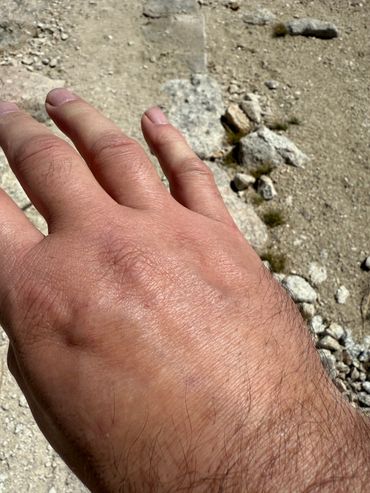
So the big push begins with the 97 or 99 switchbacks. I'm not quite sure what it is. Some people say 97, some people do say 99. But the switchbacks, it seems like an impossible, impossible for you to get up to the ridgeline, but the switchbacks a little bit to the south, and they literally are switchbacks. Back forward, back forward, back forward, back forward. But they're actually never that steep. They are constantly climbing, but because they're switchbacks, they've sort of kept the same grade. And then you reach a point on the switchbacks, I don't know, halfway up or so where there are the chains. And so the chains are sort of hammered into the side of the trail. This is a spot where apparently if there's ice and snow, it gets real sketchy. You can see there's a big drop-off, and you're glad the chains are there, even if it's just psychological. And I'd gotten ahead again a little bit, and it was probably about 80 switchbacks. I wasn't I wasn't counting, but maybe like 80 switchbacks in, all of a sudden, boom, the altitude hit me. I was at like 12,500 feet, and suddenly my pace slowed dramatically, and my breathing became heavy, and I knew I was in the zone. I had been hit by the elevation right then and there. And bear in mind, we hadn't acclimatized. And I know that Jason and Leo live at a lower altitude than Brady and I. And whoa, suddenly there we were. And I took a moment to breathe and I looked down at my hands and they were swollen. They were cold and red and swollen. And Brady caught up to me and started getting a little bit ahead of me. And I decided just to slow it down, you know, get myself a climatized to the altitude.
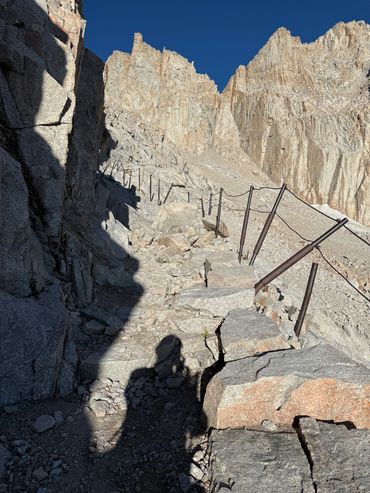
And eventually you reach Trail Crest, which is sort of a turning point where you then start going behind the peaks along the trail. And as soon as you get behind the peaks, man, is it cold. You're out of the sunlight and you're in the shadow. Uh by this time it's probably seven, I think maybe it took an hour or so to get up the switchbacks. And suddenly I'm getting freezing cold, so I have to stop, take on a little bit more fuel, and then get you know, get wet, get some warmer clothes on, some gloves and stuff. After that, it wasn't ever particularly steep, but the altitude really kicks in. And so it's just a death march to the top, just you and the trail and one foot after the other. I will say this is the most sketchy part of the hike. You know, you're behind the spires that you're looking back up from trail camp, but then you see sort of the whole Sequoia landscape opening up behind you and these dramatic drop-offs just off the trail, and you slow down because it is a bit sketchy. It's not super dangerous, but you are acutely aware of those steep drops right in front of you that you are traversing across, and the altitude is affecting you, and you're trying to make sure you don't trip over. It's quite rocky up there. So I just took my time. I would stop from time to time, pass other hikers, either coming back down or you know, I'm overtaking them going up. And the passing is a little bit sketchy. You have to be, you know, you're trying to you're passing on a fairly narrow path with these big drop-offs. So if you're doing this, just remember be kind, be be polite, because it is this is the place I think where you hear about people falling. This is this is where it's most likely happening.
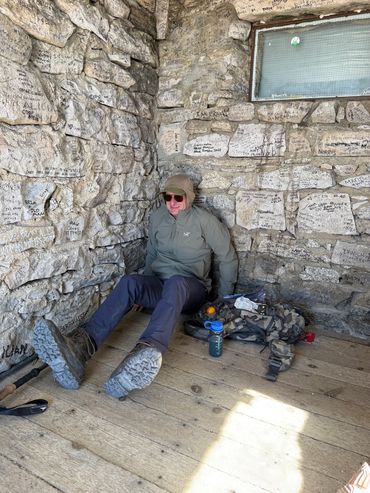
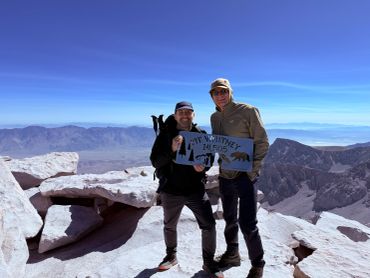
But after that piece, you start to climb up, you know, the final ascent. This is a little bit more steeper as you push your way up to the final summit of Whitney. And then you come up to like this big stone, a stone field, and suddenly you see it. Uh there's a stone hut up there that was put in there, I think, in the 1930s, and it's there, and you see it. And there are crowds of people up there, and you finally make it to that hut. And there was Brady inside the hut, collapsed, obviously, enjoying the moment, chatting with some folks, just recovering. And I came into the hut. I didn't go to the you know, the big summit peak view, and went straight in the hut, collapsed in the corner, and just like I made it. And you know, took on some water and some electrolytes, ate a little bit, chat to some, chatted to some folks. The folks there had left at 11 p.m. and had just made it up there. And we had made it up there, you know, four hours quicker than they had. So we had booked it up the mountain. And about 30 minutes later, Leo and Jason made it and popped their heads in. And so we joined the crowds. We took the big, you know, the glory shot. Look at us from the top of Whitney and held the sign. You know, we made it to the highest point in lower 48. It was really exciting. And something interesting that happens on the peak. You have that moment of elation, and you're doing all the yeah, and I did it, and we take photos, and then it's over. Like the the big, oh, all right, well, now we've got to go back down.
So we all sort of got our stuff together. And Jason and I have a joy of traveling down the mountain at pace. And I could see Jason was itching to go, and I was thinking, yeah, I've still got a lot of energy. I made it to the top, you know, I didn't have any problems. Let's uh let's see what kind of pace we can pick up down the mountain. So he gets a little ahead of me, and I'm following him. And we as soon as we hit the the first descent, he's running, I'm running, we're moving at pace. I'm sure people thought we were absolutely insane, but then we make it to the dangerous part and we both slow down, slow down quite dramatically because it is it is sketchy. You do not want to be running through there and tripping up and uh finding yourself plummeting to your death. And so we moved fairly quickly and then we hit the 99 switchbacks, and I could see Jason was sort of running. I moved at a a pretty swift pace down the trail, and I was keeping up with his little stop start runs, but I was booking it down the 99 steps at a pace, and uh eventually I caught up to him at the bottom of the trail, and we both stopped for a few minutes at trail camp. I filled up my water, took another little snack in, and continued down the trail after we waited for 15 minutes or so to just catch our breath.
And then we then we got to enjoy the glory of Whitney in the full daylight, and all those things we'd hiked through through the dark were just spectacular. You know, the ribb the ridgeline we'd climbed up, coming back in, seeing the portal open out behind you, going through these beautiful alpine forests, seeing these wonderful lakes that we'd missed on the way down. And then you get to that section I mentioned where it was forested and it opened up into a little campground, just walking across that sort of big bowl and looking up at the mountainscape was absolutely phenomenal. But then as the day wore on, we're getting into you know 18, 19 miles, and uh lo and behold, the ranger was there checking our permits. Well, I had all the permits, and Paul Brady and Leo did not have the permits, and so we stopped to start to chat with the ranger, and I was fiddling around getting the permits, and then Brady caught up, and so we showed him the permits, but Leo was nowhere to be seen. We were pretty sure he was okay and he wasn't going to get lost, and it was a pretty simple way to navigate back down the mountain. And so we told the trail ranger, if you see this guy, Leo, uh, tell him he can't pass, tell him he needs a permit, just mess with him a little bit, and then we left. And I actually never did ask Leo if he got messed around with the ranger or not. But anyway, we told him his name was Leo and he was with us and he'll be coming in a while. Um and uh but then it started to heat up, you know, the day started to get warm and the miles started to wear on, and we opened up a little gap between ourselves. Jason was up ahead, and then Brady was ahead of me, and I was sort of dragging behind.
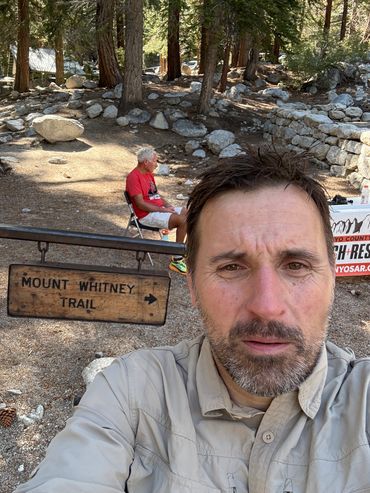
And you start going back down the switchbacks, you're getting it's getting warmer and warmer as you're moving closer and closer to the finish. And then, you know, eventually you can hear the running water of the creek, and there it is, you're back. You're back in Whitney Portal, you've done it, you've done 22 miles, 6,600 feet. When I take out the brakes that we had to take waiting, Brady and I did it in 10 and a half hours. I think the normal quick time is is 12 hours, but we had crushed it. I mean, we had we I was waiting at the bottom and this couple came down and I just asked them if they'd done it and when they started. They had started also at 11 p.m. And so we had finished the whole thing four hours quicker than than they had. And at the bottom, I'm sitting there trying to take in the stress on my body, sort of take a little breather in, and there's a SAR table set up, and there's you know, a SAR officer there, and then I see him. I'd heard about this guy, Crazy Jack. He and the other SAR guy were sitting there chatting and shooting the breeze. My hands are swollen. I thought, this is a bit worrying. Why are my hands all swollen? I thought these guys are sar, this probably happens all the time. Let me ask them, what am I supposed to do about these? So that's what I went up to him and said, Hey guys, what am I supposed to do about these? And he said, Nothing. He'll wear off. And I thought, all right then. So I met Crazy Jack sort of. But yeah, this guy has apparently climbed Whitney more than 200 times. I think he owns maybe a hostel or something in town, but he's always up and down the mountain. So if you see Crazy Jack, it's a special kind of sight. So anyway, Brady and I met up with Jason, and Jason said he'll wait for Leo. And Jay Brady wanted to get back a little bit earlier in the day, he had some stuff to do that evening, which I thought was boughty of him to climb Whitney and then drive five hours back to Reno. But we did, we left. We didn't we didn't have the famous Whitney Portal burger, which I was a little bit disappointed about. But we drove home, and so I mean, that's Mount Whitney, and that was my Mount Whitney experience.
So I did the whole thing without poles. Was it a good idea? I think you can do it without poles. The only issue is your hands might swell up. But anyway, I think out of all of the hikes I've done that are sort of that tremendous, just the grade made it really pleasant. It was just that little punch in the gut of altitude when you get up, you know, 12,000, 13,000 feet that made it really difficult. The trail at that point, if it was uh you know, 8,000 feet, would not have been that big of an issue. But with the altitude, boy, what a what a what a doozy. But yeah, absolutely one of the awesome hikes that you have to do if you get the opportunity. And I've written a guide. You can go look at that. It tells you when to go, you know, where to stay, how to get there, the segments of the trail, you know, some of the dangers you have to be aware of. I give you a little a checklist of things you should take, how much water, the types of equipment you need, and lots of uh information on you know local stores and stuff. So if you're inclined and you've got on your bucket list Whitney, sign up for the Whitney pop. We'll give it all to you to do. We'll tell you how to do it. Bish bash bosch. You can get it done. And then when you're done, fill in the finisher form. I'll send you this fantastic challenge card that we've developed. It'll be personalized with your name and the date you give you've done the climb and a unique serial number that's specific to you and will go in our database. So if you ever lose or damage the car, we'll be able to find your information and give you a give you a copy of it. So that's my story of of Mount Whitney now. Off your pop.
This website uses cookies.
We use cookies to analyze website traffic and optimize your website experience. By accepting our use of cookies, your data will be aggregated with all other user data.