Mt Fuji, Japan - Trial of the Blossom Princess
In this episode, Philip takes us through one of the most demanding single‑day traverses on Mount Fuji: a full ascent from the Subashiri 5th Station, a complete loop around the crater rim, and a long descent all the way to the Gotemba 5th Station. It’s 11 miles of movement and more than 13,500 feet of vertical change — all completed without hut rest or acclimatization. Along the way, we break down how most climbers tackle Fuji, why 60–70% sleep in mountain huts to acclimatize, and why same‑day ascents and descents are far less common.
But this episode goes deeper than the stats. We explore the geology of Fuji — how three ancient volcanoes (Komitake, Ashitake, and the modern Fuji cone) stacked themselves over hundreds of thousands of years, how the Hōei eruption blasted open the mountain’s eastern flank, and why the summit crater is a living reminder that Fuji is still an active stratovolcano. We also dive into the mythology: the story of Konohanasakuya‑hime, the blossom‑princess goddess said to dwell in the crater; the ancient pilgrim mandala around the rim; and the way Fuji’s shape, symmetry, and volcanic fire shaped centuries of spiritual practice.
This is Fuji as climbers rarely experience it — not just a mountain, but a geological giant, a mythic symbol, and a physical challenge that reveals its true scale only when you cross it the hard way.
Off You Pop Unfiltered: The Photo Gallery
Episode Transcript
Introduction
This is Off You Pop, the podcast for hikers and adventurers who want to be epic in just one day.
Today we're stepping into Mount Fuji, Japan's sacred summit. A volcano so symmetrical it feels less like geology and more like intention. We'll explore the three volcanoes that built it: the pilgrims who walked it, the goddess who inhabits it, the artists who mythologized it, and the eruption that reminded Japan that beauty and danger are siblings. This episode is also about my climb and my story in my words. This is the story behind the mountain, the geology, the Shinto cosmology, the Buddhist asceticism, the Edo period eruption, the cultural iconography, and the deep mythic presence that makes Mount Fuji feel like a place carved out of a memory and devotion. Now let's get On the Pop.
The Story of the Mountain
When you look at Mount Fuji from Tokyo or from the shores of Kawaguchiko, or from the window of a Shinkansen, you'll see one perfect cone, clean, symmetrical, snow-capped, like a logo drawn by a god with a compass. But that's a lie. Fuji is not one mountain. Fuji is a stack of ghosts. Long before Fuji looked like Fuji, there was Komitaki. Komataki was a broad ancient volcano that rose from the plains around 700,000 years ago. It didn't have Fuji's elegance. It wasn't a postcard mountain. It was a working volcano, erupting, collapsing, rebuilding, eroding, slowly becoming part of the landscape. Today, most of Komataki is buried, but it's not gone. If you stand at the fifth station on the Yoshida route, you're not standing on Fuji proper. You're standing on Komataki's old bones, dark older rocks that form the northern base of the mountain. Fuji grew on top of it like a second head. Komataki is the ancestor that never left. It holds Fuji up. It carries the weight. After Komataki came Ashitaki. Ashitaki erupted violently, spreading lava and ash across the region, shaping the foothills and plains that will one day hold towns, roads, and railways. It's less famous and less romantic, but it's part of the foundation. If Komataki is the buried elder, Ashitaki is the middle child, important, overlooked by the central. Together, Komitaki and Ashitake built the stage. Fuji was the performance. The Fuji you know, the perfect cone, the snow-capped icon, the national symbol, is shockingly young, only about a hundred thousand years old. In mountain terms, that's barely out of adolescence. Fuji grew fast, it erupted often, it layered lava and ash in repeated pulses, each eruption widening of the cone, refining the shape until it became the symmetrical form that artists, monks, and climbers have been obsessed with for centuries. The result is what you see today: a young volcano sitting on an older volcano, sitting beside another older volcano. Three mountains, one silhouette. That mountain that's still becoming itself.
And here's the thing, Fuji is not finished. Its last major eruption, the Hoyi eruption of 1707, didn't come from the summit. It tore open the southeastern flank, created a new crater, and sprayed ash all the way to Elo, the city that would become Tokyo. That eruption didn't just change the landscape, it changed the mountain's identity. Fuji is still deforming, still settling, still storing pressure. When you climb it, you're not walking on a completed masterpiece, you're walking on a work in progress. Komataki beneath you, Ashitaki around you, and Fuji above you. Three mountains laid in time, pretending to be one. Most eruptions come from the top. Fuji chose the side. On December the 16th, 1707, Mount Fuji tore itself open, not at the summit, but on its southeastern flank, and unleashed one of the most violent eruptions in Japanese history. It didn't produce rivers of lava, it didn't blow the mountains apart, it did something stranger, quiet, and far more devastating. It buried a city. Japan in 1707 was stable. The Tokugawa Shogunate rolled from Ido, the city that would become Tokyo. The country was peaceful, prosperous, and tightly controlled. Fuji had been quiet for 300 years. People assumed it was done. Then the earthquake started. For weeks, tremors shook the region, small at first, then stronger, then constant. Villagers reported strange noises from the mountains. Animals fled the forest. The air felt wrong. Fuji was waking up.
When Fuji finally erupted, it didn't come from the summit crater. It ripped open a new vent on the southeastern flank. A wound that would become Hoei Zan, the Hoeizan Mountain. The eruption blasted ash twenty kilometers into the sky. The plume turned day into night. Ash fell like snow, the air became thick, choking and metallic. But the strangest part, there was no lava. This was a dry eruption, pure ash, pumice, and volcanic debris. A storm of stone. Ado buried in grey. The ash cloud drifted east, and east was Ado. Within hours the city was covered, roost collapsed under the weight, crops died, rivers clogged, the economy faltered. The shogunate panicked. People thought the world was ending. Some believed Konohanasakuya-hime , Fuji's goddess, was angry. Others believed the mountain was cleansing the land, and few believed it was a warning. Fuji had spoken, and it had spoken loudly. The towns closest to Fuji suffered the worst. Entire villages were buried, fields vanished under meters of ash. Water sources were poisoned, the landscape changed permanently. The people of the region rebuilt, but they rebuilt on top of the ash. Even today, farmers dig into soil that contains the remnants of the Hui eruption. Fuji's anger is still in the earth. The eruption didn't change the landscape, it changed Fuji itself. The new crater, Hoeizan, is still visible today. A massive scar on the southeastern flank that looks like a second summit, a broken tooth, a reminder that Fuji is not the perfect cone that people imagine. Fuji is beautiful because it's dangerous. Fuji is symmetrical because it's young. Fuji is quiet because it's waiting. Scientists monitor Fuji constantly. Pressure is building beneath the mountain.
The Houi eruption is the blueprint for what could happen again. But now Tokyo is bigger, closer, and more vulnerable. Fuji is not extinct. Fuji is not sleeping. Fuji is paused, and the last time it unpaused, it broke the sky. Most mountains begin at a trailhead. Fuji begins at a shrine. Before you touch the volcanic ash, before you see the Tori gates, before you join the long line of headlamps climbing on into the night, you pass through a doorway, a threshold between the human world and the mountain world. Fuji is not climbed, Fuji is entered. And the entrance is always the same.
A Sengin shrine, the goddess of the mountain, Konohanasakuya-hime e, Fuji's deity, is the blossom princess. She is the Khmai of fire, volcanoes, cherry blossoms, birth, renewal, and beauty that hides danger. Her myth is extraordinary. She married the god Ninigi, became pregnant and was accused of infidelity. To prove her innocence, she locked herself in a hut and set it on fire, giving birth inside the flames without being burned. That is Fuji's personality in a single story. Beautiful, volatile, purifying, and alive. Konohanasakuya-hime is not a symbol. She is the mountain. The Sengin shrines, Fuji's gatekeepers. There are over 1,300 Sengin shrines across Japan, all dedicated to the Blossom Princess, but three matter the most. Fujisan Hongu Sengin Tasai, the head shrine, the spiritual capital of Fuji worship. This is where pilgrims begin their journeys for over a thousand years. They prayed for safe paritage, they purified themselves, they entered the mountain's domain. The shrine's architecture is massive, elegant, and unmistakably volcanic. Dark wood, sweeping roofs, and a sense of quiet authority. It's the front door of Fuji, Fujisan Hongū Sengen Shrine, the northern gateway, older, quieter, and more atmospheric. This shrine sits at the base of the Shida route, surrounded by towering cedar trees that feel ancient enough to remember Komataki's eruptions. Pilgrims walked from Edo to this shrine, stepped in its lodgings, and began their ascent at dawn. The cedars are so tall they feel like columns in a natural cathedral.
Murayama Sengen Shrine. This shrine once controlled the entire mountain. In the medieval period, Murayama's monks regulated climbing, maintained the roots, and performed rituals on the slopes. They were the mountain's custodians, the original rangers' guides and guardians. Today, Murayama is quiet, overshadowed by the most famous shrines, but its legacy is everywhere on Fuji. Climbing Fuji was never just physical, it was spiritual. Pilgrims performed misogi, ritual purification before ascending, that included washing hands, rinsing mouths, bowing at the Tori gate, offering coins, and praying for safe passage, asking the goddess for permission. The idea was simple. You don't climb Fuji as you are, you climb Fuji as someone prepared. The mountain is a place of rebirth. You must arrive ready to die and be remade. Every Fuji route begins with a Tori gate, a red or wooden arch, marking the boundary between the mundane and the sacred. Passing through a Tori is not symbolic, it is literal. You step out of the human world and you step into the mountain world. You step under the protection and judgment of the blossom princess. The Tori is the moment the climb becomes a pilgrimage. Fuji is not just a volcano. Fuji is a deity with a front door. The shrines are the mountain's introduction, its guardians, its history, its ritual and its identity. They are the reason Fuji feels different from any other climb. They are the reason the mountain has gravity beyond geology. They are the reason people cry at the summit.
Fuji is not climbed for the view. Fuji is climbed for the transformation, and every transformation begins at the shrine. Most mountains are climbed by individuals, but Fuji's origins was as a mountain that was climbed by societies. For nearly 300 years, from the 1600s to the late 1800s, ordinary people across Japan formed pilgrimage clubs dedicated entirely to one purpose. Climb Mount Fuji once in your life. These groups were called Fujiko. They turned Fuji from a mountain into a movement. During the Edo period, Japan was stable, peaceful, and closed to the outside world. Travel was restricted and life was predictable. Most people lived and died within a few miles of their birthplace. But Fuji was different. Fuji was a symbol of purity, rebirth, spiritual transformation, and national identity. And so in towns and villages across the Kanto region, people formed Fujiko, climbing guilds, spiritual clubs, mountain brotherhoods. Membership wasn't elite, it wasn't aristocratic, it wasn't religious in the formal sense. It was ordinary people, farmers, merchants, and craftsmen, who believed that climbing Fuji once would change their lives. Fujiko pilgrims didn't climb in hiking gear, they climbed in white robes, the color of purity and death. White meant you were leaving the human world. You were entering the sacred world, you were symbolically dying and were preparing to be reborn. They carried long banners with the names of their Fujiko groups fluttering in the wind like declarations of devotion. Imagine hundreds of people walking towards Fuji dressed in white, carrying banners and chanting prayers. It wasn't a hike, it was a procession. Most Fujiko groups began their pilgrimage in Edo, modern Tokyo, and they walked through villages, across rivers, past the ridesfields, and into the foothills towards the mountain that dominated the horizon. The journey took days, sometimes weeks. They slept in inns, they prayed at roadside shrines, and they sang devotional songs. They carried Fuji in their minds long before they reached its base. By the time they arrived at the Sengen Shrine, they were already transformed. Before climbing Fujiko, pilgrims performed purification rituals. They washed their hands and rinsed their mouths, bowing at the Tori gate before they began their climb. They chanted sutras and offered coins and asked the blossom princess for permission. They believed the mountain was alive, they believed the goddess was watching, they believed the climb was a negotiation with the divine. You didn't climb Fuji because you wanted to, you climbed Fuji because you were called.
The stations on Fuji 1 through 10 were not rest stops, they were ritual thresholds. For each station, Fujiko pilgrims prayed, chanted, burned incense, recited mantras, and left offerings. The climb was a ladder of purification, and each station was its rung. Each step was a shedding of the old self. By the time they reached the summit, they were symbolically dead. At the top, Fujiko pilgrims walked the crater rim, a full circle around the summit. This was called the Ohachimeguri the bowl circuit. It was the final ritual, a walk around the mouth of the volcano, a symbolic journey around the world, a rebirth in the presence of fire and the sky. When they finished the circuit, they were considered spiritually renewed. They descended as different people. The Fujiko transformed Fuji from a mountain into a culture engine. They created the climbing routes, they maintained the stations, they built the shrines, they established the rituals, they spread the Fuji worship across Japan and turned the climb into a national rite of passage. Without Fujiko, Fuji would not be the mountain it is today. They made Fuji a pilgrimage, they made Fuji a symbol, they made Fuji a story, and every modern climber, every tourist, every hiker, every sunrise seeker is walking in their footsteps.
Most mountains have a trail. Fuji has a staircase. A staircase made of volcanic ash, cedar forest, tourie gates, shrines, huts in the sky. Ten stations rising from the human world into the realm of the goddess. The stations are not restops, they're thresholds, each one the wrong on a ladder that climbs out of ordinary life and into something older, stranger, and more sacred. And at the base of that ladder, you receive the object that will carry your story up the mountain. The walking stick. Your passport to the mountain. Before you take your first step, you buy a kongozu, a Fuji walking stick. It's not a hiking pole, it's not equipment, it's a ritual object. The stick is your companion, your record, your symbol, your offering, your proof, and your story. At each station you can have it branded, burned with a hot iron stamp that marks your progress. The stamps aren't decorative, they're spiritual. Each brand is a blessing, each mark is a memory, and each burn is a moment. By the time you reach the summit, your stick is no longer a stick, it's a biography.
The climb begins at station one, in the forest, cedar, cypress, and volcanic soil. This is the world of people, roads, and noise. Station one is the last place where Fuji feels like a mountain. After this, it becomes something else. Station two is the first threshold. Here the air changes and the trees thin and the path narrows. Pilgrims once perform purification rituals here, washing hands and rinsing mouths, preparing to leave the mundane world behind. Station three is the old pilgrims' lodges. In the Edo period, station three was a bustling hug of Fujiko pilgrims. They slept here, they prayed here, but today the lodges are gone, but the atmosphere remains, quiet, expectant, and ancient. At station four, the forest begins to fall away, the trees shrink, the volcanic ash deepens, and the mountain begins to reveal its true shape. Your stickrace is another brand, a bone mark that marks your passage to the mountain's domain. Station five is where most modern climbers begin, but historically station five was the midpoint of the pilgrimage, the place where Komataki's ancient bones lie beneath your feet. Here you feel the first breath of altitude, the first hint of cold, the first sense that Fuji is watching. Your stick receives a brand that marks your entry into the sacred zone. Station six are the ashfields. The path becomes volcanic gravel, black, loose, and shifting. Every step sinks, every step demands effort. This is where the climb becomes a negotiation. Your stick receives a brand that marks your endurance. Station seven are the huts of fire and wind. The huts of station seven are built into the mountain like fortresses, wooden, weather beaten, and stubborn. Pilgrims once lit lanterns here. Today, climbers drink miso soup and gather strength. Your stick receives a brand that marks your resilience. Station eight, the realm of the goddess. The air is thin, the wind is sharp. The volcanic rock is jagged and ancient. This is where the blossom princess's presence becomes palpable in the silence, in the cold, in the way the mountain seems to narrow around you. Your stick receives a bran that marks your devotion. Station nine is the final ascent. The slope steepens, the path becomes a zigzag carved into volcanic stone. The summit shrines appear above you like silhouettes against the sky. Pilgrims once chanted here. Modern climbers whisper encouragement to strangers. Your stick receives a bran that marks your nearing rebirth. And station 10, the summit, the mouth of the volcano. You reach the top, the crater opens before you, vast, circular, and elemental. This is the realm of fire and sky, the throne of the blossom princess, the place where the pilgrims died symbolically and we were reborn. Your stick receives its final brand, the summit seal. You now carry a record of your ascent burned into wood, a story you can hold, and a memory you can touch. Fuji stations are not waypoints, they're chapters. Each one is a step in a ritual, each one is a rung on a ladder, each one is a burn on your walking stick. Together they turn the climb into a narrative, the story written in ash, altitude, and fire. Fuji is not climbed in one motion. Fuji has climbed in ten thresholds, and the walking stick is the book that remembers them.
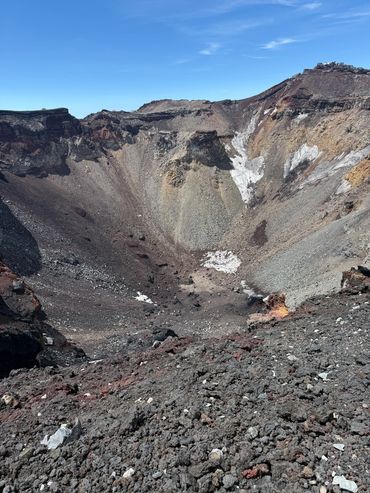
Most mountains end at a point, but Fuji ends at a circle. When you reach the top of Mount Fuji, you don't arrive at a peak. You arrive at a rim, a volcanic crown surrounding a vast crater that feels less like geology and more like architecture. This is Ohachi the summit crater, a ring of shrines, wind, sky, and silence, a place where pilgrims walked in circles to be reborn. Fuji's summit is not a destination, it's a ritual. Ohachi is enormous. 500 meters across and 200 meters deep, a bowl carved by fire and time, but it's not empty. Inside the crater are jagged lava cliffs, sulfur vents, snowfills that survive into summer, volcanic ridges shaped like frozen waves, and the inner walls of Fuji's young cone. It looks like a wound and feels like a temple. The crater is the mountain's heart, exposed to ancient and alive.
Fuji doesn't have one summit. It has eight. The crater is a rim of peaks, each with its own name, history, and personality. Kengamine is the true summit and the highest point in Japan. Shiragengamaini is the white peak. Jojudake is named after an era of eruptions. Hoeizan is the scar of the 1707 eruptions.Oshaidake is the sound peak. Komagatake is the horse peak. Kusushishimini is the medicine peak. And Fusima. Fujinan Maini is the Fuji Peak. The pilgrims didn't climb to one summit, they climbed all eight. They walked the entire rim, a full circle around the mouth of the volcano, chanting sutras, praying for rebirth, and acknowledging each peak as a facet of the goddess. The ritual was called Ahachimiguri, the bowl circuit. It was the final act of the pilgrimage. Kengamine is the tallest of the eight pigs, standing at 3,776 meters, which is 12,338 feet. But reaching Kengamine is not the end. It's the beginning of the Crater ritual. Pilgrims stood here not to celebrate, to prepare, to walk the rim, to complete the circle, to finish the transformation. Kengamine is the threshold, not the finale. In Buddhist cosmology, a mandala is a sacred diagram, a circle representing the universe. A hachai is a mandala made of rock. The crater's shape mirrors cosmic diagrams with ritual circles, the cycle of death and rebirth, and the wheel of existence. Walking the rim was not exercise, it was enlightenment. You circled the mouth of the volcano the way the monks circled sacred halls. You walked around fire and sky the way pilgrims walked around temples. The crater is a mandala you entered with your feet. At the highest point of the crater, six, Okumaya, the inner shrine of Fujisan Hongur Singen, Tak Shai. This is the throne of the Blossom Princess. Pilgrims offered coins, prayers, chants, walking sticks, and their old cells. The shrine is small, simple, and powerful. A wooden structure perched on the rim of the volcano, watching Japan from above. It's the highest shrine in the country, the closest place to the sky you can stand without leaving the ground. The Sonic wind is not the normal wind. It's cold, thin, sharp, constant, and ancient. It carries volcanic dust. It carries the scent of sulphur. It carries the silence of the crater. Pilgrims believe the wind was the goddess's breath, a reminder that the mountain is alive, aware, and watching. And standing on the rim, you feel it. You feel her. The crater is the key to Fuji's identity. It's the mountain's true summit. Its heart, its mandala, its ritual, and its story. Fuji is not a peak, it's a circle. And when you walk that circle, when you complete the Ohachi-meguri you're not just climbing a mountain, you're entering a universe.
Shugendo, the mountain monks and the path of suffering that leads to power. For most people, climbing Fuji is for the sunrise, some climb it to meet the gods. Long before tourists lined up at midnight with headlamps and energy gels, Fuji was the domain of Shugendo, the mountain religion that fused Shinto Buddhism and something older, stranger, and harder to define. Its practitioners, or Yamabushai, mountain ascetics who believed enlightenment came not from temples, but from suffering, and Fuji was their crucible. Shugendo is not a doctrine, it's a practice. Its core belief is simple. The mountains are alive, the mountains are sacred, the mountains will change you if you let them. Yamabushai sought endurance, purification, spiritual power, communion with nature, and transcendence through hardship. They didn't meditate in quiet halls, they meditated on volcanic slopes. They didn't seek comfort, they sought exposure. They didn't avoid danger, they walked straight into it. Fuji was the ultimate test. It had fire, ice, altitude, storms, silence, volcanic ash, and sacred shrines, and a crater that felt like a cosmic mouth. Yamabuchi believed the mountain was a living being, a teacher, a judge, and a gateway. And climbing Fuji wasn't a journey, it was an ordeal. Historical accounts describe Yamabushi climbing Fuji barefoot, in white robes carrying conch shells while chanting sutras and performing rituals at each of the stations. Their bare feet on volcanic gravel, their bare feet on jagged lava, their bare feet on ice. They believed pain was purification. They believed hardship burned away illusion, and they believed the mountain would be real truth only to those willing to suffer for it. Yamabuchi carried poragai, conch shell trumpets. They blew them at the shrines and the ridges and the crater rims, in storms in fog and in silence. The sound is eerie, a long, low, trembling note that echoes across the slopes like a voice calling from another world. It wasn't music, it was communication, a signal to the mountain and a declaration of presence. Fuji's lower slopes were dotted with lava caves, dark, cold, narrow chambers formed by ancient eruptions. Yamabuchi meditated inside them for hours, sometimes days. They believed the caves were the mountain's veins, a place where the boundary between human and divine thinned. Emerging from the darkness was a symbolic rebirth. The Blossom Princess, Fuji's deity, is the goddess of fire. Yamabuchi honored her with huatari, firewalking rituals. They walked across burning coals. They chanted, they prayed, and they asked the goddess for strength. Fire was not a threat. Fire was a teacher. And Fuji is a volcano. To understand the mountain, you must understand fire. For Yamabuchi, reaching the summit was not the goal. The goal was transformation. At the crater, they performed sutra recitations, conch shell calls, and purification rites, and the full circuit of the crater. Walking the rim was the final test, a symbolic journey around the mouth of creation. Standing there, Yamabuchi believed they were closer to the divine than anywhere else on earth. Shugendo shaped Fuji's identity. The Yamabuchi established rituals and defined the mountain's sacred geography, creating the spiritual meaning of the climb and influencing Fujiko pilgrims. They preserved the mountain's mythology and treated Fuji as a living being. Without them, Fuji would be a volcano. Because of them, Fuji is a pilgrimage. They turn suffering into enlightenment, they turn the climb into a ritual, and they turn the mountain into a teacher. Fuji is not just the place you go, Fuji is a place that changes you.
More than any mountain on Earth, Fuji has been drawn, painted, carved, printed, photographed, animated, and branded into cultural memory. It's not just a landscape, it's a symbol, a shape that Japan keeps returning to again and again as if the mountain were a mirror. Fuji is the most depicted mountain in human history, and every depiction tells a different truth. Katsushi Hokosai didn't just paint Fuji, he canonized it. His 36 views of Mount Fuji, which eventually became 46, transformed the mountain from a physical place into a national emblem. Each print is a mood, Fuji in Storm, Fuji in calm, Fuji at dawn, Fuji in winter, Fuji Towering, Fuji behind fishermen. Fuji is a backdrop to ordinary life. Fukusai's genius was simple. He made Fuji universal, not a mountain you visit, a mountain you live with. Fuji became a constant, a presence in the background of Japan's imagination. If Hukasai mythologized Fuji, Utagawa Hiroshiga romanticized it. His landscapes, especially the 53 stations of the Takaida, show Fuji as misty, distant, gentle, atmospheric, and dreamlike. Where Hukasai's Fuji is bold and graphic, Hiroshiga's Fuji is quiet and emotional, a mountain glimpse through rain, fog, or the corner of a traveller's eye. Hiroshiga painted Fuji the way people actually see it. Not as a destination, but as a comparison. Long before woodblock prints, Fuji appeared in medieval scrolls, pilgrimage maps, temple diagrams, travel diaries. These early depictions show Fuji as a sacred peak and a cosmic axis, a place where gods descend and the site of miracles. When photography arrived in Japan in the late 1800s, Fuji became one of its first subjects. Early photographers captured the crater rim, the shrine as the pilgrimage, the volcanic slopes, the mountains of Tokyo Bay, the mountains from Ricefields. These images turned Fuji from myth into documentation, proof that the mountain was real, not just legendary. Fuji appears everywhere in modern Japan. Anime openings, manga panels, tourism posters, corporate logos, product packages, fashion, advertising, emojis, video games. It's a shape so iconic that you can draw it with three lines, and everybody knows what it is. Fuji is not just a mountain, it's a brand. But unlike most brands, Fuji wasn't disarmed. It emerged naturally and inevitably because the mountain silhouette is perfect. Fuji is Japan's virtual shorthand for beauty, endurance, purity, tradition, nature, spirituality, and resilience. It appears on all of their major documents. Fuji is a mountain Japan shows the world when it wants to say, This is us. Fuji is ongoing. When you stand on the crater rim looking across the bowl of frozen fire, it's easy to think the mountain is finished. A masterpiece completed thousands of years ago.
But Fuji is not a relic. Fuji is in process, a volcano in mid-sentence. And Japan scientists watch it the way you watch somebody who might wake up. Fuji is still active. Officially, scientifically, and unequivocally. Fuji is classified as an active volcano by the Japan Meteorological Agency. Not dormant, not extinct, active. Why? Because Fuji's erupted over a hundred times in the last 2,000 years. Its most recent eruption, Hui in 1707, was only 319 years ago. The mountain still produces seismic tremors, pressure is still building beneath the cone, and the magma chamber is still connected to deep volcanic systems. Fuji is quiet today, but quiet is not safe. Fuji sits on one of the most complex tectonic intersections on Earth. Three plates meet Batita beneath Japan, the Pacific Plate, the Philippine Sea Plate, and the Eurasian plate. This triple point creates subduction zones, deep magma pathways, and frequent earthquakes. Fuji is plugged into a geological engine. When the plate shifts, Fuji fills it. In 2000, something happened. A swarm of over 1,000 small earthquakes rattled Fuji's northern flank. They were shallow, rapid, and clustered, the kind of tremors that often precede volcanic activity. The scientists detected magma movement pressure changes, gas fluctuations, and microfactures in a rock. For a moment, Japan held its breath, but Fuji didn't erupt. But it reminded everybody that it could. Fuji's magma chamber is unusual. It's large, complex, multi-layered, and connected to older volcanic systems capable of producing explosive eruptions. The Hoi eruption didn't come from the summit, came from a flank vent, meaning pressure found a weak point and punched through the sides, and that can happen again. In fact, scientists believe the next eruption is more likely to be flank-based than summit base. Fuji doesn't erupt neatly, it erupts where it wants. Tokyo is only a hundred kilometers from Fuji. It's much larger, denser, and more vulnerable than in 1707. A modern Hoei eruption could shut down airports, cripple transportation, contaminate water, overload hospitals, disrupt power grids, and cause economic shock waves. Fuji is not just a mountain, it's a national risk. Japan watches Fuji closely. The mountain is monitored by seismographs, GPS deformation sensors, gas emission detectors, thermal imaging satellites, ground-based radar and volcanic activity models. The scientists track its activity. Fuji is one of the most closely watched volcanoes on Earth because it has to be. Japan uses a five-level volcanic alert system, and Fuji is currently at level one, normal, but active. Level two would restrict access, level three would close the mountain, level four would evacuate nearby towns, and level five would be a full emergency. Fortunately, Fuji hasn't risen above level one since the system was created. But it is active, monitored, dangerous, unpredictable, powerful, and unfinished. Fuji is a volcano that watches Tokyo. A mountain that could change the country in a single day. A reminder that beauty and danger are siblings. And when you climb it, you're not standing on a monument, you're standing on a possibility. Now let's get On the Pop
On the Pop: My Journey
I planned my ascent of Fuji for July 18th, which was a Saturday. And it was one week after the official trail, so they'll open on Mount Fuji. Now to climb Fuji, you need to get a permit. They're pretty easy to get, and I think they cost around $15. You have to download an app from um to your phone and then pay for the permit. And do do this step because you're going to need it when you get to the start of the trail. There is a hut at the beginning of each of the trailheads with some monitors who will check that you have the app and you have your QR code, and they'll scan the QR code and check that you're okay to go up the mountain. And make sure you get your permit for the trail that you intend to climb. So I intended to climb Subashiri and then descend by Gotemba. So I got a Subashiri permit. And after that, nobody checks. But at the at the very trail here, you do need to get uh the permit in place. And you can't you can't start your climb of Fuji before 2 a.m. or after 4 p.m. There's some restrictions on the mountain, they don't want people rushing up and down and starting odd times. They're really encouraging people to acclimatize on the mountain and stay stay in the huts, spend a little bit more money on the mountain and get used to it now. My intent was not to do that. I'm a fairly good hiker, fairly strong hiker, so my intent was to go up and down in a day. I think about 60% of the people will do Fuji by staying in a mountain hut. So they'll start later in the afternoon, maybe around noon, and make their way up to you know six or seven station and then sleep at seven or eight thousand feet so they can get acclimatized before the next morning or early in the early the next morning and traveling up to the summit. And many people like to try and make it up there at sunrise. I wasn't attempting to do that, I was attempting to go up and down in one day and not staying a hut. So my intent was to start at 5 a.m. and then finish when I finished.
So I stayed in the town of Kawaguchiko, and this town is on the lake, on Lake Kawaguchiko, and it's about a 30-minute ride from the Yoshida trail here, maybe 45 from the Subashiri Trailhead. And so I decided to stay in this beautiful hotel called the Fuji View Hotel. When we arrived, it was kind of raining and clouding, and we couldn't see Fuji, and we didn't actually see Fuji until the morning that we left a couple of days later. And so we were just taking word for the hotel that it was indeed the Fuji View Hotel. Although, in reality, if you stay in Fuji Fujiko, I think you get the Fuji View from almost anywhere you stay, unless you're pointing in the right direction, uh the wrong direction, uh, across Lake Kawaguchiko. But, it was a nice place to stay. And I had arranged to get a taxi from the hotel in in Kawaguchiko to the trailhead at Subashiri. Now you can get buses there. You can go to the station, there's a nice bus station, there's plenty of buses that will take you to the Yoshida Trail, which is the more common, shorter trail that lots and lots of people take. The Subashiri trail is a bit further out, and because I wanted to leave so early in the morning, I didn't want to sort of get hampered by missing a bus or trying to deal with navigating the bus timetables. I arranged for a private cab that cost me about $100 in the end to get from the hotel to the trailhead. And so I left the hotel at about 4:15 a.m. and got to the trailhead around 5 a.m., sort of at first light. And you wind your way up out of out of the town and up into the mountain. And you don't start at the base of Fuji. Most people don't start at the base of Fuji. You can start at the base of Fuji, but I think it's going to be a real long day. There's a road that takes you all the way up to Fifth Station, and uh Fifth Station is technically halfway up the mountain. Although it's still a long climb for the day, still another 6,000 feet of climbing from halfway. You can start from zero from station one, and that's gonna be a very, very long day, and you probably will want to stay in the mountain hut for that experience.
So I arrived at five and a bus came up behind me as well. So there was a bunch of people about to start the trail. And when I got off, there's uh a number of little shops there that were actually open at 5 a.m. I got a little bit of food, I got a bean paste and a Snickers or something, just to get a bit of food in me. Nothing was open at 4 a.m. at the hotel. And uh I bought one of these little walking sticks. You can buy a long walking stick, like full-length, like six-foot walking stick, but you just buy a little short stick that you can just put in your pack. And I saw a bunch of people on the mountain with the long sticks using it like it like it was a hiking pole. It's actually not intended to be a hiking pole, it's intended to be sort of a symbolic ritual, as we discussed earlier in this episode. So I just bought the shorter version. Uh, so I could collect stamps as I went up to the mountain. And it was cloudy and misty and kind of damp. And I put on my my raincoat before I started the trail. And then there was another guy there, it was an American guy. Wasn't very chatty, didn't really want to talk to me. I tried to make some conversation, but he sort of, I said, Are you American? He's like, Yeah, I'm America. And that was about the sums of our conversation. I did see him, uh, at least up through Seven Station. So for a good few miles, we were sort of ping-ponging a little bit up the mountain, but after Seven Station, I didn't see him again.
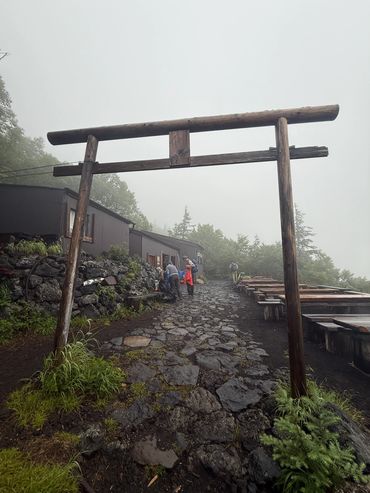
So you start out in a you know, a fairly flat path, you walk past these stores, and then you get to this little cabin. And there are some folks there who work as rangers, I suppose. At the at the beginning of the trail, and you get ushered into uh into a hut to show your QR code, and uh they scan your QR code, got a little badge um symbolizing it was a 2026 hike. Uh they wave waved me on my way and they were wishing good luck and waving very happy, happy, happy rangers. It'd be a little bit bizarre to experience that in the US, but it was really a nice, a nice experience and a nice send-off. And quickly you get into the forest, and there's a set of stairs that you start climbing up. As you get away from the lower part of Fifth Station, uh, you turn the corner and you head up a straight set of stairs to a little shrine. This is a shrine that's you know, the shrine for Fifth Station, a place where you sort of, if you're a Shinto or Buddhist, you say your prayers and ask for permission from the Blossom Princess to allow you to go up to the mountain. And I certainly saw I saw uh a Japanese guy in front of me was doing a ritual, so I gave him a bit of space and let him do the ritual, and then uh went on my way. And quite quickly you're in the forest and it's starting to ascend, and it really doesn't ever let up the ascent of the Subashiri Trail.
It's not stone steps all the way, it's pretty quickly off on onto a rocky volcanic trail, and you're going up through some sort of volcanic rocks, just wet and damp and cloudy. And the reason is that the cloud has settled down low on the mountains. So you are literally walking through the clouds, but you can only tell it's when you get to the top of Fuji that and you're looking back down, you look down above the cloud line. But when you're starting out the hike, it just feels like a miserable wet day. But the humidity in July in Japan is is stifling to say the least. Now, 5,000 odd feet where you start the climb in Subachuri, it's not hot, at least not at five in the morning, but it still feels like heavy and humid, and you've got a raincoat on and you're sweating. So I just remember the sweating so intensely at the first part of this hike. And it was steep. I mean, when you see Fuji from a distance, you see this perfect cone volcano. And for some reason, in my mind, that didn't translate to a perfectly steep, consistent, constant hike. But the way that they've designed the trails is it pretty much is a consistent, constant, uphill hike that just slowly gets steeper and steeper and steeper and steeper. It does uh switch back at a certain point, but that's closer, that's much closer to the start. You're just going up, up, up. The only places where it really flattens out are around the little stations. And so after fifth station, it's about an hour to get to sixth station, so it's a bit of a walk. You sort of follow up this volcanic gully, and you're slowly climbing out of the forest, and the trees are getting shorter and thinner, and you're looking up, and all you can see are the clouds. You can't see the top of Fluigi, but you are starting to see these big volcanic fields. And as you're climbing up, get to a point where you hit the first station.
And the first station, this is sixth station, and there are a couple of people there hanging out. The American guy didn't want to talk to me. I let him go ahead of me to start with, so I could eat at fifth station. And he was there eating some noodles. And there was a woman there. My first experience getting my walking stick stamped, so I gave her the walking stick, I think it was 300 yen or 500 yen, somewhere around there for each of the stations, you give them money and then they stamp a stick. So she let me take a little video of her stamping the stick. I didn't do that again anywhere else up there now, just the first the first one. But I was suffering mightily from the from the the humidity. It was really really kicking my butt going up the mountain. Wasn't the altitude, wasn't the strenuosity of the climb. It was just that I was wearing a raincoat and it was extremely humid and I was sweating buckets. So I had to take a moment at six station just to get some electrolytes in me and sort of let let myself cool off a little bit. And I realized that it wasn't necessarily raining and so I needed to make a decision to take my jacket off because wearing that plastic raincoat was really making me making me miserable. So I I decided at that point just take the raincoat off and if it really rained I'd put it back on. I was wearing sort of a dry with t-shirt underneath when it was July it wasn't cold or freezing or anything so I just decided to to suck up the the dampness of the cloud effectively.
And so it continued past six the sixth station and the climbing begins. I overtook a couple more hikers and coming up again just this continuously steep volcanic forested area and uh quite quickly you make your way out of the forest and you pop up to old six station. So there's a there's a sixth station and an old sixth station I came up past these American kids who were playing music and enjoying themselves and I see they see they see me sweating and they'd stopped and we're taking a break and I'm power hiked past them and I'm not taking breaks no not really not really but I was suffering badly at the bottom and uh got to old six station and we were all there together. There was a couple of other American couples, bunch of people there trying to get their stick stamped. And so uh way their line got my stick stamped and I sort of left before everybody else I was planning to do this hike the way I normally do hikes you know it's a uphill slog, downhill run and I don't tend to stop very much and hang around to be on the trail, like to be suffering I guess from from the ascent. So although I'm complaining right now about the humidity it was part of my regular experience to suffer somewhat.
And so soon I was kinda on my own again and now you're back in this black volcanic field and the cloud is still around you but the trail is just mercilessly steep. It just keeps going up and up and up. There's no lead-off whatsoever you just go in this 30-40 degree angle all the time and start coming up into the clouds and I come across this a little wooden arch like maybe up to your waist there's a bunch of coins laying on the ground and stuck in the top of this little arch and I realized this was a ritual place where you sort of give a blessing to the goddess where you leave a coin and you do a little you know little shinto ritual and so I left a I left a coin. I didn't do the shinto religion I think it involves bowing and and clapping a couple of times and I didn't I didn't do that. I'm not Shinto or Buddhist so I just went on my way and the other American guy overtook me again going up past sixth station he stayed about you know 50 yards 100 yards in front of me after that I'd sort of let him pass because I needed to dry out you know dry out from my sweatiness but kept going up and up and up and it was just steep and relentless through the clouds
Quickly you're up through Subashiri into 7th Station and 7th Station was real busy. Seventh station was a popular place and it had a a kitchen that was humming people were getting noodles and stuff and hanging out and sitting on benches and there were a bunch of people there. And I tried to get a stamp and they said we don't we don't do stamps we just give you a sticker I guess I'll take the sticker but I never applied the sticker to the walking sticker. It didn't feel right but seven station definitely marks the change in geology from you know that older you know first eruption is that second eruption where you can tell that the the ground is changing somewhat it becomes a bit looser and a bit more black and dark and the trees are no longer visible. So I just stopped again just for a quick break ate a little bit of food drank a little bit of electrolytes and then just went on my way the other American guy I see him get more noodles so I didn't I was pretty sure I wasn't going to see him again. I'm sure it was 15-20 minutes to eat some food right there.
I was just gonna power on through and I will say after seventh station it became ridiculously steep. It was brutal the climb from seventh up to eighth is brutal. It's just steep and straight up really not that many switchbags just straight up and you are coming out of this sort of midsection this middle volcano into this loose exposed stuff up through the clouds and I was kind of tracking behind this Japanese guy who was a little in front of me. He was moving slightly slower than me but not really I was sort of gradually catching him I gradually overtook him but it was it was miserably steep and eventually you sort of come out of the cloud and uh you come up to 8 station. Again another opportunity for a walking stick another group of people up here hanging out eating and drinking and uh I went kind of past A Station a little bit because I wanted to sit down have a proper rest because that that segment from 7th to 8th was so punishingly steep. I was I was feeling it I was just feeling the brutality of the uh the ascent at that point and I really wanted to get a lot of liquid in me and a lot of a lot of food and stuff and you know some some quick sugars some gels and whatnot so I sat down and I realized that this was the point where the Subashiri Trail joined the Yoshida Trail. And the Yoshida Trail is really the popular one. It starts near a town it's higher up the mountain everybody's um starting from that so there was suddenly a lot more people around and
I sat by a rock just a little way away from the from the store and I started seeing these lines and lines of people coming out of the mist down the mountain. It's really interesting I think this is the the section where you move from that middle section that ashitaki section up into the Fuji section because right here it's where the rock turns from black into this deep red volcanic layer. It was really interesting because the cloud's starting to thin a little bit every now and then you'd see a patch of opening and you look up and there you could see finally the peak of Fuji but it seems so far above you. It's still 2,000 meters it's still a solid climb fully exposed fully straight up but it's so far you see this line of tiny little people making their way up zigzagging their way all the way up to the top of the mountain and so I'm sitting there minding my own business like drinking a pot I'd purchased and um eating some food and then there's this woman in like construction outfit standing at the junction and she comes over to me and she's like move move danger danger you must move danger from what there's nothing here. And so I she moved me basically 10 meters off of the little bit I was sitting at a junction and it was at the junction of this road and suddenly rumbling out of the darkness comes this sort of whirring medley noise and I see these headlamps coming up this road is this little four trap vehicle with a little guy inside driving it up the mountain and he's coming up the mountain and this is these are these little four tracks that come up this road that's not really part of the trail. It's a separate road system but it comes up and it supplies all of the stations with supplies and so I was standing right I was sitting right at the point where it does sort of a little turnaround. And so it would have sort of whooped around and potentially crushed me beneath it. So she did me a favor by just moving me out of the way of the turning circle of this this little machine but it was kind of a little bit surreal seeing it coming out of the mist and then turning around and going back up into the mist up into the trail and people coming down the Yoshida trail were sort of in the way and had to get out of the trail a little bit.
So I finished what I was doing and got my stuff all packed up ready for the final ascent up to as I found out old eighth station then ninth station abandoned ninth station and then finally to the summit. And so this part is is different but it's steep and now it's zigzaggy and steep so it's kind of it's take it's gonna take a while to get to the summit. You know that from this point. And I think I'm about three and a quarter hours in and I know it's still 2,000 feet to get to the top. So I start up the road where the four track went and see the Subashiri trail goes off into a proper trail so you're off the road. And at this point I think that they've designed the trail so there's some ascending trails and some descending trails. So you're never really bumping into people coming back down the mountain because you're going on a trail that's designated to go up the mountain. And now you're on the Subashiri slash Yoshida trail.
And so now it becomes sort of this exercise of just slogging up the uh the zigzags and so pretty quick you're up to old ape station uh old eigth station there's uh the Fushida hotel just little um station you can stay at a lot of people will stay up here to make the sunrise ascent uh it's a little bit off the trail but you can see it even through the mist and then again there's another little store and a couple of those vehicles were parked up there. I stopped in there got got another stamp and I saw this American woman there and she's got a canister basically an aerosol canister with like a mouth a mouth thing on it. It's oxygen that you can just like pump in. It's not a full-on oxygen tank but it's like a little aerosized uh tank that you could buy and I thought that was a little odd. I guess we're at like maybe 10,000 between 10 and 11,000 feet at ninth station I asked her if it worked and she didn't really respond but I wasn't feeling the altitude which was good but I could start to sense around me that people are really starting to suffer from the altitude at this old ape station. And the old eigth station is feels a little bit more ancient it's a it's a good place to take some photographs and stuff but above old ape station you could really start to sense that the hikers around you were suffering and they were moving a lot slower, taking a lot more breaks. They're almost breaking every switch back. But uh I've been climbing in the Sierras you know a couple of weeks before I've been up five or six mountains over 10,000 feet and I wasn't really feeling the altitude.
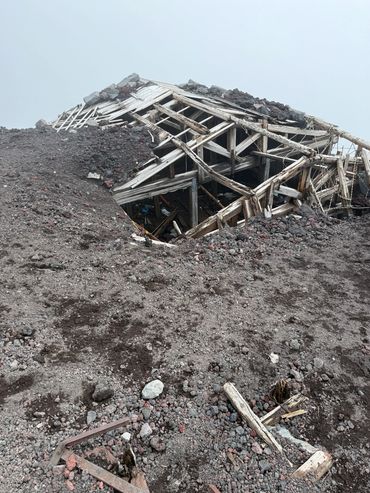
I was fine and now and now the clouds have started to lift it wasn't feeling so sweaty but you start to climb out of the cloud line and you start to feel it because the the cloud becomes thinner the views at the top become less obscure suddenly you're in in sunshine but now you can see the top of the mountain where you have to go and it's still a distance. So you continue zigzagging up to the final ascent you get to ninth station and ninth station is derelict it's been wiped out by shifting volcanic soil and it's just a frame. A bunch of people are hanging there obviously suffering from the altitude just sat for a minute to take a break and then just you know head down slogging up the switchbacks all the way all the way to the top after that I didn't really stop overtook a whole bunch of people on the way up here didn't nobody really actually apart from the American guy back down at Seven Station nobody really overtook me on the way up I didn't realize what good time I was making it just felt like I was suffering immensely from the humidity the whole way up and I was moving miserably slow. But as I discovered later I made it in a real good time. I think I made it up in under five hours and even with even with what felt like a whole bunch of wasted time breaking I just you know I I went up constantly slogging my way up through and as you get closer to the stop you start to see the very top and the rim there's a big Japanese flag and there's uh one of these Tori gates that lead to the rim and the last little section is much rockier and much more direct than the other sections but
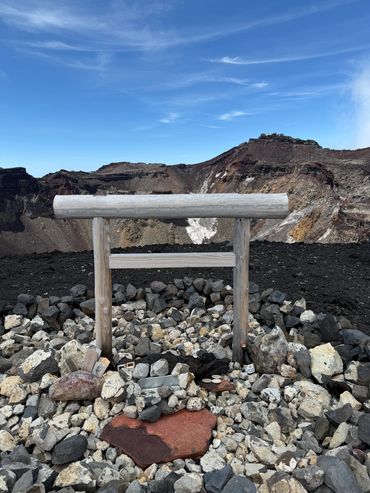
very quickly you're coming up some some steps and you know this is the final ascent to the rim and there's these foo dogs either side of the final ascent under the Tory gate and you finally make it through the Tory gate and you're there and you've made it to the top of Fuji and it's such a great feeling and right there is a shrine with some monks and they are they're stamping sticks too so I took my stick over there and this was a real special feeling like to get to this gate and this shrine to get this stamp on your walking stick. Unlike the rest of the stations they will take a hot iron and sort of burn into your stick monks took a powder like a red powder the rest are sort of black charcoal marks they took the red powder and they hit it with a hammer and sort of stamped it with this red powder into the into the walking stick sort of that final you've made it to the top this is it I stood there took a few photos obviously memorializing that I'd finished the trail and made it to the top but it was not finished by a long way today.
My plan was to go around the rim to do the Mendala effectively and then descend by Gotemba the a different trail entirely and sort of discovered afterwards nobody's really doing this. A lot most people go up and down the trail they went on get to the top you know take a picture and go back down again but we're doing it the difficult way so started to make my way um anti-clockwise around around Fuji so turned right when I got through the gate and started my way making my way around I found a little side trail and a little sort of a trig point and a little shrine that overlooked into the crater and stood there just admiring the magnificence of this crater 500 meters down into the earth and just astonished by how how spectacular and how massive the crater is when you get up there. Cannot hike down into the crater you have to hike around the rim if you're going to hike anywhere up there. So just follow the trail around the rim following past all the peaks that make up the rim that was pilgrims uh climbed hundreds of years ago and eventually made my way I don't know why I went this way because it seemed it seemed to get murderously hot you know the sky opened up the clouds lifted you were now way above the clouds it was just a beautiful glorious blue sky day but the rook the way I'd chosen to go around the rim it was like a a little drop down into like a you know a lower section of the rim and then a murderously steep climb up to the steepest part. So I had this constant climb all the way back up to the steepest part of the rim. And at the steepest part of the rim is a weather station and another you know little symbol that you've made it to the top of the highest part of the rim there were a whole bunch of people there taking photos and videos and stuff. I didn't stay very very long but enough to say I'd done it and you know take a photo and went back to the main trail of the rim and took a little bit more video and this wonderful Japanese couple was was standing there and was taking a little video and they got into the background of it and just a charming couple in the background waving for my limited audience let's put it that way and started to my make my way around back to the Gotemba trail and around the rim which was a little bit downhill and stuck feeling a little bit more lively after the murderously humid light to the top and eventually made my way to the trailhead at Katemba was a little shrine. Just took a brief rest one last you know glimpse at the magnificent crater that is inside the top of Fuji and then started to make my way down and as
I'm making my way down Gotemba it felt very different to Subashiri. And it was very rocky at the top and and there were lots of rock outcrops with sort of gravel on top that made it a little bit slick coming down. And as I'm starting to make my ascent I notice all these folks coming up and they are clearly dressed for trail running and they've made their way all the way up the Gotemba trail trail running. Now they're power hiking up and I'm sure they'd power hike their way all the way up but later I was to discover why the trail runners were coming up up this very steep trail. And uh I actually was feeling a little bit hot and exhausted at this point coming back down gotemba because I didn't really stopped hadn't really sat and it a eaten a meal and now I'm probably about six seven hours into the hike after I've done the after I've done the the rim and the mandala and up up Subashiri. Just some energy gels and some liquid but you know I I'm unplugging away and unplugging on made a bit of a mistake and fell on my butt and then started to get off this rocky section and it sort of eased off a little bit went sort of switch backing started to become less rocky and more grabby and I just stopped and uh just took a moment to get some more energy on before really powering down through the rest of the climb.
I wanted to come down Gotemba because I heard about this break sand run and I was expecting this spectacular scree run that would go on for a couple of hundred yards and that would be the end of it. So you come off of Gotemba you go past a couple of stations on your way down I'm pretty sure it's you hit 9th station Gotemba it didn't stop there and kept going and then you hit 7th station Gotember and that's the end of the stations. There's no more stations after 7th station in fact it's completely desolate after 7th station so until you reach new fifth station at the trailhead. So if you are tired and thirsty and need to get something 7th station Gotemba is your last chance after that complete desolation trust me no trees no water no nothing it's the great sand run. So I came off of Gotemba after passing a whole bunch of people that were sitting at the station or you know making their way up and making their way down. As I'm coming out of seventh station I start getting into this sort of loose scree stuff this must be the great sand run I only went for a couple of hundred yards as far as I could tell and I thought well this is this is all right it ain't all there.
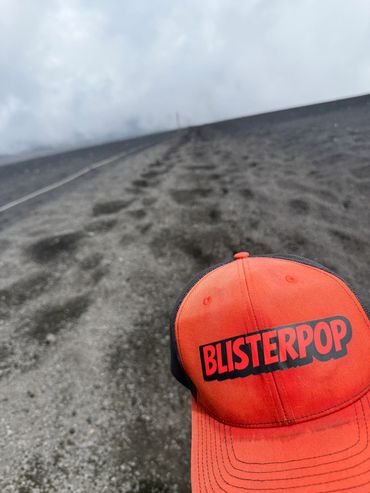
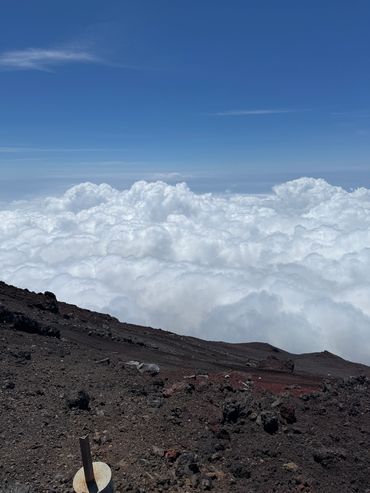
So I went down a couple of hundred yards and as I rounded the corner the gravel this dark black heavily gravel got deeper and more more sort of soft and your your feet went into it much more deeply and I suddenly realized now I'm in this full on screen run and it just goes on and on and on and on I can't see the end of it. And I'm coming out of the sunshine I'm coming back into the cloud level. You know when I was sitting on the rim looking down at Gotemba you could just see the tops of the clouds billowing below you know a thousand or so feet below you the top of the clouds above it beautiful blue sky day. And as I'm starting to make my way into the into the great sand run those trailrunners I saw near the top are starting to now run past me and I'm I'm picking up the pace. I'm moving I'm not fully trail running because I have a pack on but you know a decent sized pack. I am moving a pace and I'm passing the few people that are on the gotimba side that are not trail running pretty rapidly and making real good pace and I thought well this is going to be over any of three or four hundred yards it wasn't. It just kept going on and on and on as far as you could see was this big black field of this loose gravel that you sort of sank into you know slightly above your ankle and you go down sort of surfing down the great scree run. It was just such a beautiful experience but it just goes on for like three or four hours of you sinking into this stuff. And eventually as you're making your way down the mountain your your legs start to become taxed by the continual sinking. You have to sort of get the right motion and rhythm going to ride ride the scree down. As you get toward the bottom it kind of levels out and hardens out a little but your legs aren't used to it. So you've got yourself into this sort of scree running motion with sort of stiff legs and suddenly it it gets solid on you and it jolts your legs but the spree kind of continues onward and downward and so eventually you're making your way back into the mist and back into the cloud level and so the world sort of shrouds around you again as you're making your way back down.
Eventually although very tired and beaten up I made it to Gotemba New 5th station which is the lowest point of the trail and it's actually significantly lower than Subashiri. You lose a lot more altitude than you've gained during the day you end up losing somewhere in the region of 7,200 feet whereas you gain 6,000. So you start a little bit higher on Subushiro it's very steep, very sharp and then you have this beautiful ascend down Gotemba through the great sand mine ending at this basically a tourist show. And I knew my day was done it was 115 I'd done it in like eight hours and 15 minutes. Even with all the breaks that I felt like I took I'd done it super quick. I think most people are doing Fuji in like 12 to 14 hours so we'd really we're really crushed it and I think partly it was the you know slogging through Suba Shiri but also just the the beauty of the scene getting into a real rhythm of scree running all the way down the trail. The bus wasn't due till 255 so I had like an hour and a half to sit and wait. And so I decided to sit there for a little bit. And it was starting to rain a little bit so I got under a underneath the shelter of the store and I got something they sold to me as Mount Fuji shaved ice and it was it was pretty good. It was kind of a mixture of ice cream and shaved ice in the shape of Fuji which is the shape of the shaved ice you know and uh and I wanted a beer too so I sat there and I'm in the rain celebrating my rebirth I guess uh enjoying a shaved ice and a beer and then I called my taxi driver who said he'd pick me up and he gave me his WhatsApp account so I I gave him a call and he I said remember it's me you were going to come pick me up and he let me know he was sightseeing and he wouldn't be able to pick me up so I was kind of stranded there for a bit but fortunately I was able to figure out a taxi back to the town of Gotemba which is off the mountain and then back into this town and then and then figure out a way to get back to my hotel rather than wait an hour and a half for the bus.
But as I came off news New 5th station you have to go down to the parking lot for Gotemba. It's about five minutes but as soon as I got back on the trail the heavens opened and I just got soaked. It was ridiculous. Very last bit soaking all the way through and went to the parking lot of Gotemba News Station and there's a place where you can wait for the bus. And so I got to the gift store there and was trying to call a taxi to take me to Gotemba but I couldn't figure out how to make it work and the shop owner was nice enough to call a cab for me so I only had to wait 15 20 minutes when I got a cab back to to the town of Gotemba and then made my way back to Kawaguchiko. But I mean what a spectacular climb just such a unique climb so steeped in mysticism and tradition and you know challenging difficult ascent if you're not an experienced hiker this is one that's gonna really push you because of the the angle of ascent the altitude the humidity in the summer you can really only climb Fuji in July or August which is hot. If you do it my way I don't really see anywhere online where people have done you know up Subashiri, around the rim of the crater and then down Gotemba most people are going up and down one trail even less people are doing the full you know mandala around around the rim. Just this combination was a beautiful experience.
So if you're an experienced hiker and you want to do Fuji, I highly recommend this way you avoid all the crowds of Yoshida and you do miss a bit of the temples at the beginning but you can visit them the next day and just see this see the shrine at the bottom it's right in town if you want to go see it. The Subarashiri is much more well less traveled but you still get the experience of the stations going up you get the much more challenging and more difficult and longer uh ascent up to the rim. And then you do the full rim circuit it's about it took about 45 minutes or an hour. It wasn't as long as people were suggesting it would be and not too many people are doing the rim circuit. It's surprisingly sparse considering the amount of people that are hanging around the trailheads at the top around the stores and the monks and whatnot when you get out on the rim not so many people there's still people but not not so many. It's not that crowded because very few people are making that extra ascent around the rim. And then coming down to 10 but just such an experience I recall about halfway down I was getting a little bit lost and I was by that Hui crater we discussed earlier in the podcast and when I was there at the Hui crater there is a way to go off and see the Hoi Crater but it was covered in cloud and there was a definitive branch in the trail I wasn't exactly certain which way to go. I sort of wanted to see the Hoi crater but I didn't see any point in the cloud. I saw a trail runner comes by and I just I stopped him and I asked him you know is this the way down to Gotemba 5th station he said yeah and then we started talking about trail running and how excited he was and he was comes out every weekend and does this trail run and if I was local and I had the Gotemba Great Sand run to do I think I'd probably be out there every weekend as well. It's such an awesome descent so soft on the knees and such a beautiful a beautiful run. But yeah if you're a more experienced hiker coming down got Gotemba is just such a unique hiking experience just such a beautiful descent and just endless. You do have to deal with logistics if you're gonna do it this way getting to Suba Shiri is a little bit more complicated. Getting back down from September is very complicated because there's a very defined bus schedule that will take you to the town and you have to figure out to get from the town back to wherever you're staying in the area. But totally unique experience totally awesome I feel like the Fujiko you know this is once my once in a lifetime opportunity to experience such a glorious mountain and uh I'm really glad I did it and I think if you have the opportunity and it's not on your bucket list you should 100% consider doing this mountain. Now Off You Pop.
This website uses cookies.
We use cookies to analyze website traffic and optimize your website experience. By accepting our use of cookies, your data will be aggregated with all other user data.